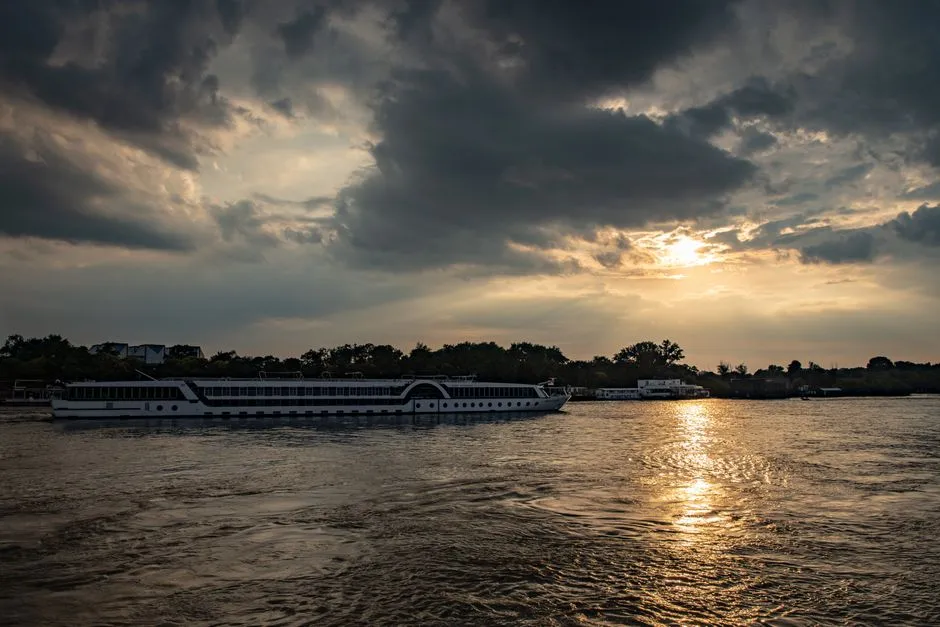
The Viking Longship is the most-built single class of river cruise ship in history. Since the prototype Viking Idun launched in 2012, more than seventy near-identical vessels have been delivered to a single specification: 135 metres in length, 11.45 metres in beam, three passenger decks, and 95 staterooms accommodating 190 guests. The hulls are built in Rostock, Germany, and outfitted in Hungary; the design is the work of marine architect Yran & Storbraaten in collaboration with Viking founder Torstein Hagen.
What sets the Longship apart from earlier 110-metre Rhine vessels is the asymmetrical layout of the upper deck. Where competitors run a central corridor with cabins on both sides, the Longship's top deck has a wider corridor offset to one side so the cabins on the other side can be 30 percent larger — the so-called Veranda Suites and the bow Explorer Suite. The Explorer Suite is the only true two-room suite in the Viking river fleet at 445 square feet, with a wraparound veranda overlooking the bow.
Cabin categories run from the 150-square-foot Standard Stateroom on the Main Deck (with a high fixed window) to the 205-square-foot Veranda Stateroom on the Upper Deck (with both a French balcony and a step-out balcony in the same cabin). Mid-tier cabins on the Middle Deck have French balconies only. All cabins use the same neutral Scandinavian palette and the same Vispring mattresses; the differences between categories are square footage, deck height, and balcony configuration rather than fittings or finishes.
The Longship's public spaces are organised front-to-back rather than top-to-bottom. The Aquavit Terrace — the casual, open-air bistro at the bow — is on the Upper Deck immediately ahead of the Lounge. The main restaurant is one deck below, mid-ship. The library, reception and small fitness room are on the Main Deck. The sun deck is fitted with an organic herb garden, a putting green, a walking track and shaded lounge furniture; it is closed when the ship transits low bridges.
From an itinerary perspective the Longship is built for the Rhine, Main and Danube — the three rivers whose locks and bridges fix the maximum vessel dimensions in Europe. Viking does not deploy Longships on the Seine (where the Forseti class is configured for French waters) or the Douro (where the smaller, four-deck Helgrim class operates), and the brand's newest Egyptian Nile and Mississippi vessels share styling cues with the Longship but are otherwise different ships.
If you are comparing one Longship to another, the only meaningful operational difference is the year of build. The earliest hulls (Idun, Embla, Tor) had a slightly different sun-deck layout that was revised in the 2014 batch; the 2018 and later hulls added USB charging in every cabin and upgraded Wi-Fi infrastructure. Otherwise, sailing on Viking Egil is functionally identical to sailing on Viking Heimdal — that uniformity is the entire point of the class.
Continue reading
AmaWaterways twin-balcony staterooms: which ships have them and what they really mean
The twin-balcony cabin is AmaWaterways' most-marketed feature. Here is a fleet-by-fleet breakdown of which ships actually offer them — and which only have a French balcony.
European river cruise ship amenities compared: pools, spas, bicycles and inclusions
A side-by-side look at what is actually onboard the seven major European river cruise lines — from heated pools to bicycle fleets to all-inclusive shore excursions.
Rhine vs Danube: which European river cruise should you choose first?
Both the Rhine and Danube are entry-level European river cruises. They are not the same trip — and one of them is almost certainly a better fit for a first-time guest.
Mekong river cruise ships compared: AmaWaterways, Avalon, Aqua, Pandaw and the boutique fleets
The Mekong is the second-largest river-cruise market outside Europe. Here is how the seven operating fleets actually compare.
Nile river cruise ships compared: from 200-passenger floating hotels to 16-cabin dahabiyas
The Nile cruise market is the most fragmented in river cruising. Knowing the four main vessel categories is the difference between the right and the wrong booking.