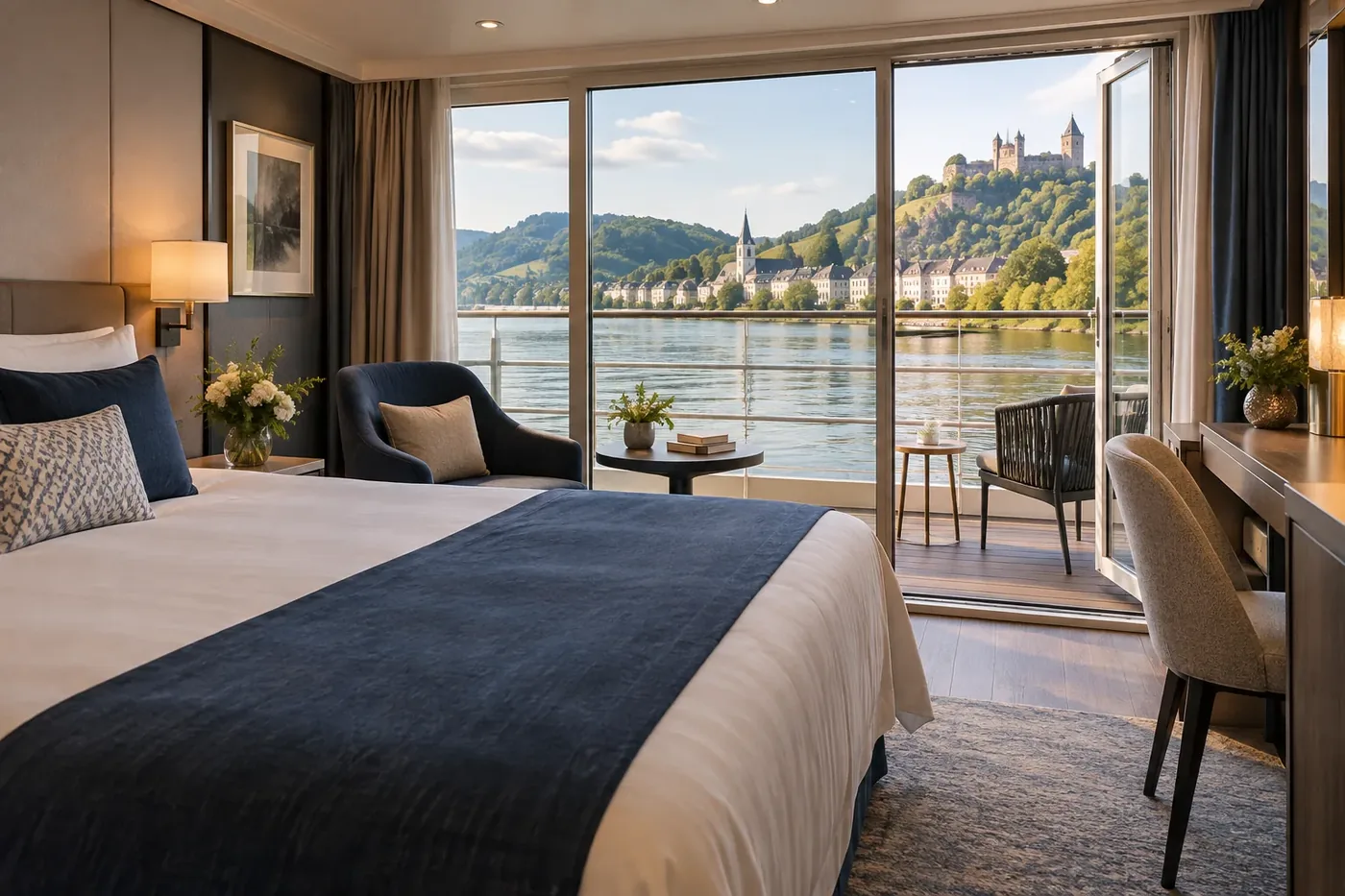
The "twin balcony" stateroom — a single cabin with both a French balcony (a floor-to-ceiling glass door that opens onto a railing) and a step-out balcony with deck chairs — is the design feature most closely associated with AmaWaterways. It first appeared on AmaCerto in 2012 and was rolled out across the European fleet over the following decade. But the configuration is not standard on every AmaWaterways vessel, and on the smaller and older ships it is not offered at all.
The twin-balcony layout is restricted to the Cello Deck (middle deck) of the so-called "European" class — AmaCerto, AmaPrima, AmaSonata, AmaReina, AmaSerena, AmaStella, AmaViola, AmaKristina, AmaLea, AmaMora, AmaSiena, AmaLucia and AmaMagdalena. On these ships, around 60 percent of cabins are twin-balcony, with the remainder being French-balcony-only on the Piano Deck or window-only on the lowest deck.
The flagship AmaMagna — at 22 metres wide, twice the beam of a standard Rhine vessel — has the largest twin-balcony cabins in the fleet at 355 square feet. Suites on AmaMagna are 474 square feet with a separate seating area. Because of her width AmaMagna can only operate on the Danube, where the Vienna-Bratislava-Budapest stretch has the lock chambers to accommodate her.
The smaller AmaDouro and AmaVida — both purpose-built for the Portuguese Douro — do not have twin balconies because the river's lock dimensions cap the ship's width. Cabins on these vessels are 140-145 square feet with a French balcony only. Similarly the Mekong-based AmaDara and the Nile vessels AmaDahlia, AmaMelodia and AmaLilia use a different cabin layout suited to tropical climates: a deeper French balcony with louvered shutters rather than the European twin-balcony arrangement.
If a twin-balcony cabin is the deciding factor, the practical advice is to (1) confirm the ship is in the European class, (2) request a specific cabin number on the Cello Deck (typical numbers run 211–235), and (3) confirm at booking that the category code maps to "BB" (twin balcony) rather than "BA" (French balcony only). The price difference between BB and BA is typically 8–12 percent of the cabin fare.
Continue reading
Viking Longship class explained: deck plan, cabins and what makes the design different
A complete walkthrough of the 190-passenger Viking Longship — the most-built river cruise vessel of the modern era — from sun deck to main deck.
European river cruise ship amenities compared: pools, spas, bicycles and inclusions
A side-by-side look at what is actually onboard the seven major European river cruise lines — from heated pools to bicycle fleets to all-inclusive shore excursions.
Rhine vs Danube: which European river cruise should you choose first?
Both the Rhine and Danube are entry-level European river cruises. They are not the same trip — and one of them is almost certainly a better fit for a first-time guest.
Mekong river cruise ships compared: AmaWaterways, Avalon, Aqua, Pandaw and the boutique fleets
The Mekong is the second-largest river-cruise market outside Europe. Here is how the seven operating fleets actually compare.
Nile river cruise ships compared: from 200-passenger floating hotels to 16-cabin dahabiyas
The Nile cruise market is the most fragmented in river cruising. Knowing the four main vessel categories is the difference between the right and the wrong booking.