If this is your first European river cruise, the practical choice is between the Rhine (Amsterdam–Basel) and the Danube (Passau–Budapest). Both are seven or eight nights, both are operated by every major line, both depart between April and November, and both stop in famously photogenic Old World cities. They are nonetheless very different trips.
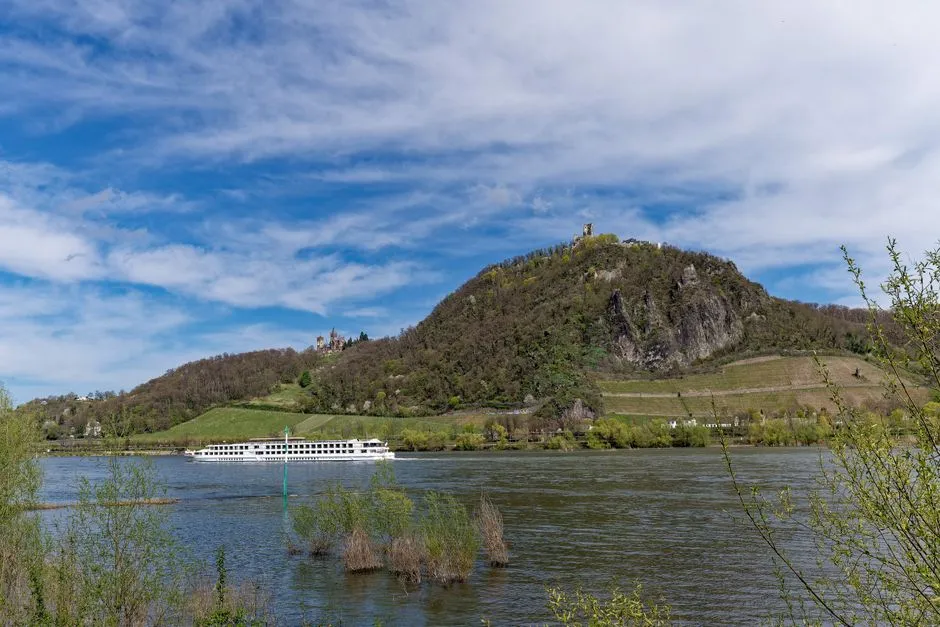
The Rhine is a sequence of medium-sized German towns: Cologne, Koblenz, Rüdesheim, Speyer, Strasbourg, Breisach. The headline scenic stretch — the Middle Rhine gorge between Bingen and Koblenz — is roughly four hours of slow sailing past forty hilltop castles. Excursions are heavy on Roman ruins, Gothic cathedrals, half-timbered villages and Riesling tastings. The river is busy: at any point in summer you may see another cruise ship every twenty minutes, and most port calls share a quay with two or three other vessels.
The Danube is a smaller number of larger and more imperial cities: Vienna, Bratislava, Budapest, with shorter stops in Linz, Passau, Melk and the Wachau Valley. The scenic stretch is the Wachau between Melk and Krems — vineyards, the apricot orchards of Spitz, the cliff-top monastery at Dürnstein. Excursions favour Hapsburg palaces, music (Mozart, Strauss, Liszt), and central European cuisine. The river is markedly less busy than the Rhine; ships often have a port quay to themselves overnight in Vienna or Budapest.
The case for the Rhine first: the scenery is more constantly engaging, the towns are smaller and more walkable, and the variety of countries (Netherlands, Germany, France, Switzerland) is greater. If you have only one week and you want to see something new from the deck every hour, take the Rhine.
The case for the Danube first: the cities are bigger and more famous, the cultural weight is higher (a Vienna State Opera evening or a Budapest thermal bath cannot be matched anywhere on the Rhine), and the river feels less crowded. If you are a city traveller more than a scenery traveller, take the Danube.
The case for combining them: Viking, Avalon and several other lines offer 14- and 15-night Grand European itineraries that run Amsterdam to Budapest end-to-end via the Rhine-Main-Danube canal. These transit Würzburg, Bamberg, Nuremberg and Regensburg in addition to the standard Rhine and Danube ports. They are the deepest single dose of European river cruising that any line offers.
Continue reading
Viking Longship class explained: deck plan, cabins and what makes the design different
A complete walkthrough of the 190-passenger Viking Longship — the most-built river cruise vessel of the modern era — from sun deck to main deck.
AmaWaterways twin-balcony staterooms: which ships have them and what they really mean
The twin-balcony cabin is AmaWaterways' most-marketed feature. Here is a fleet-by-fleet breakdown of which ships actually offer them — and which only have a French balcony.
European river cruise ship amenities compared: pools, spas, bicycles and inclusions
A side-by-side look at what is actually onboard the seven major European river cruise lines — from heated pools to bicycle fleets to all-inclusive shore excursions.
Mekong river cruise ships compared: AmaWaterways, Avalon, Aqua, Pandaw and the boutique fleets
The Mekong is the second-largest river-cruise market outside Europe. Here is how the seven operating fleets actually compare.
Nile river cruise ships compared: from 200-passenger floating hotels to 16-cabin dahabiyas
The Nile cruise market is the most fragmented in river cruising. Knowing the four main vessel categories is the difference between the right and the wrong booking.